

A | The ouster of Sri Lankan President Gotabaya Rajapaksa has roused substantial global media attention, particularly in light of the colorful images coming out of the country of protesters storming his opulent Colombo residence and turning it into a tourist attraction, posing for selfies, and organizing pool parties and cookouts.,But the chaos in Colombo isn’t the first time in the last decade or so that a head of state has been ousted from office in a time of crisis and forced to flee, with the last dozen years witnessing at least five comparable cases.,Ashraf Ghani’s Bags of Money,Last August, a ten-day blitzkrieg offensive by the Taliban* to capture cities in the midst of the NATO withdrawal culminated in the fall of Kabul and the collapse of the Afghan government. President Ashraf Ghani, the US-educated academic-turned president, fled the country he ruled at the West’s behest for seven years.,Ghani evacuated Kabul on August 15, the same day that Taliban fighters entered the city, and eventually ended up in the United Arab Emirates, where he took refuge. Ghani apologized to his countrymen and women for bolting, saying that leaving the capital “was the most difficult decision” of his life and that he took it to avoid a repeat of the bloody street fighting witnessed in the city between government and Taliban forces in the 1990s. In addition, he said, his security team had advised him not to stay due to the risk of assassination or capture.,The Russian Embassy in Kabul painted a different story, alleging that Ghani fled the city in a convoy of vehicles stuffed with so much cash that it could not fit in a helicopter which took him out of the country. UK media later alleged that Ghani may have sought to smuggle as much as $169 million in cash out of Kabul, with a former bodyguard later confirming that the ex-president’s entourage was carrying “many big bags” containing “hundreds of millions, perhaps billions of dollars.”,Ghani has categorically rejected the allegations against him, and has said that he would welcome an international investigation to clear his good name.,AfghanistanEx-Afghan President Ghani Says He Was Made 'Scapegoat' for Fleeing, Blames Trump - Report 31 December 2021, 03:27 GMT,Evo Morales’ Happy Ending,On November 10, 2019, Bolivia’s long-serving democratic socialist president Evo Morales was forced to step down after weeks of protests sparked by an election whose results were disputed by the country’s US-backed opposition. Characterizing the crisis as a “coup” and fearing he would be killed by assassins hired out by his enemies, Morales fled to Mexico, where he was granted asylum by President Andres Manuel Lopez Obrador.,The Trump administration hailed Morales’ ouster, with the US president tweeting that the unrest sent “a strong signal to the illegitimate regimes in Venezuela and Nicaragua that democracy and the will of the people will always prevail.”,But the anti-Morales’ plot’s victory was short-lived. Immediately after touching down in Mexico, Morales vowed that he’d remain in politics, and that his “fight” against “discrimination and humiliation” would continue.,In late 2019, after the election victory of leftist forces in Argentina, Morales traveled to that country, where he was granted asylum. In November 2020, after new elections in his home country saw the victory of Luis Arce, his former finance minister, Morales triumphantly returned to Bolivia. Today, although he is not president, Morales remains a major force in Bolivian politics, consistently attacking “Yankee imperialism” and recently calling on Bolivia and Argentina to join forces to become a global lithium-producing superpower.,The fate of his adversaries has not been so bright, with Jeanine Anez, the right wing politician who took over after Morales’ ouster, recently sentenced to ten years in prison for her role in the 2019 coup.,© Photo : Twitter / @evoespuebloFormer Bolivian President Evo Morales during his triumphant return to his home country in November 2020.Former Bolivian President Evo Morales during his triumphant return to his home country in November 2020.© Photo : Twitter / @evoespueblo,Yemen’s Hadi,In 2012, Yemeni politician Abdrabbuh Mansur Hadi seemed to have the world at his feet. Succeeding President Ali Abdullah Saleh, whom he faithfully served as vice president starting in 1994, Hadi won the February 2012 presidential elections with an impressive 100 percent of the vote, running as the sole candidate. He proceeded to initiate a US- and Saudi-supported reform program aimed at transforming Yemen into a federal model of government under which six regions would enjoy large-scale political autonomy. Hadi also supported ramping up cooperation with Washington to fight piracy in the Gulf of Aden, and al-Qaeda** cells attempting to set up shop in Yemen’s sparsely populated northeastern territories.,Hadi’s reforms, allegations of corruption, and the ill-fated decision to end fuel subsidies in 2014 proved fatal, and between late 2014 and early 2015, much of the country was overrun by the Houthis, an Islamist, social justice-oriented political and militant movement dominant in the country’s populous western provinces. In January 2015, Hadi left his presidential palace in Sana’a for the last time, and, without resigning, flew to Saudi Arabia.,© AP Photo / Hani MohammedShiite Houthi tribesmen hold their weapons as they chant slogans during a tribal gathering showing support for the Houthi movement, in Sanaa, Yemen, Saturday Sept. 21, 2019Shiite Houthi tribesmen hold their weapons as they chant slogans during a tribal gathering showing support for the Houthi movement, in Sanaa, Yemen, Saturday Sept. 21, 2019© AP Photo / Hani Mohammed,Two months later, in March 2015, a Saudi-led military coalition began a military operation in Yemen aimed at restoring Hadi to power. Seven years on, the coalition has made little progress, and the impoverished southern Arabian nation remains mired in a deep political, military, economic and humanitarian crisis. Meanwhile, the Houthis have counterattacked by launching drone and missile strikes targeting Saudi infrastructure, military bases, airports, oil facilities, missile defense systems and cities, with no amount of sophisticated US-made air defense hardware seeming sufficient to stop the attacks.,As for Hadi, the exiled president resigned from the post in April, transferring power to an eight-member ‘presidential leadership council’ tasked with negotiating a permanent ceasefire with the Houthis.,Saudi Arabia ‘Pushed’ Yemen’s Hadi to Resign, Placed Him on House Arrest - WSJ17 April, 22:22 GMT,Ukraine’s Yanukovych,Of all the ejections from office featured in this list so far, perhaps none have been more consequential to the geopolitical instability being experienced by the world today than that of Ukrainian President Viktor Yanukovych.,Yanukovych handcrafted the crisis which would culminate in his ouster in the winter of 2013 by pulling a major political U-turn and rejecting an association agreement with the European Union in favor of closer ties with the Russian-led Eurasian Economic Union. The decision prompted pro-EU protesters to flood the center of Kiev, with demonstrators establishing tent encampments and occupying the heart of the city – the Maidan Nezalezhnosti (lit. ‘Independence Square’).,Protests continued for weeks, with Yanukovych making concessions under EU pressure, accepting the resignation of the government of Prime Minister Nikolai Azarov in late January, and negotiating with an increasingly emboldened opposition to try to resolve the crisis.,On February 20, protests turned bloody, with 49 demonstrators and four police officers killed by mysterious snipers in a single day. On February 22, just a day after reaching an EU-backed agreement on the settling the crisis through early elections, Yanukovych fled Kiev in fear for his life, traveling east and slipping across the border into Russia, where he was offered refuge. Pro-European forces in Ukraine’s parliament drafted a resolution to strip Yanukovych of power, claiming he had “withdrawn from his duties in an unconstitutional manner.” From Russia, Yanukovych blasted the new authorities, and characterized his ouster as a coup d’état.,Kiev, Washington Responsible for Failure of Minsk Peace Agreements, Ukraine's Former President Says14 March, 15:17 GMT,Tunisia’s Ben Ali,On January 14, 2011, President Zine El Abidine Ben Ali’s 24-year reign as Tunisian leader came to an end, with the president and his family fleeing the country to Saudi Arabia after weeks of protests which would hail the start of the so-called ‘Arab Spring’. The ‘Tunisian Revolution’ was driven by long-standing grievances among Tunisians about corruption, high unemployment, inflation, and general poor living conditions, as well as limitations on freedom of speech. The protests were sparked by 26-year-old street vendor Mohamed Bouazizi, who set himself on fire in the street after police confiscated his wares when he failed to pay a bribe, and after his plea for help from the local governor was left unanswered. The young man's act, which would cause over 100 copycat immolation attempts, would spark a month of protests which culminated in Ben Ali’s ouster.,After his ejection, the Tunisian president would live to a ripe old age of 83, passing away in Jeddah, Saudi Arabia in September 2019. But the unrest which his removal sparked would end up transforming much of the Middle East and engulfing some of its countries in crisis which continue to reverberate to this day. In 2011, major protests rocked Algeria and Yemen, and led to the overthrow of the government of Hosni Mubarak in Egypt. In Libya, NATO lent a ‘helping hand’ to anti-government rebels by launching a campaign of airstrikes against forces loyal to Muammar Gaddafi, culminating in his ouster and televised murder, and turning Libya into a failed state. The contagion of the Arab Spring also spread to Syria, which was turned into a breeding ground for jihadist militants who flocked to the country from the region and across the globe to take part in the unsuccessful US, Turkish, Saudi and Qatari-backed campaign to try to oust the government of Bashar Assad.,Ousted Tunisian President Ben Ali Buried in Saudi Arabia - Reports21 September 2019, 17:53 GMT,* An organization subject to United Nations sanctions for terrorist activities.,** A terrorist group outlawed in Russia and many other countries.。 原标题:山西大同浑源县悬空寺 悬于绝壁的古建明珠(文化中国行·华夏博物之旅·传统建筑)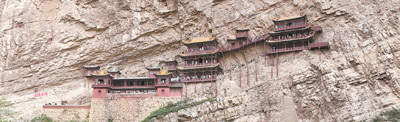 悬空寺远景。王帆摄
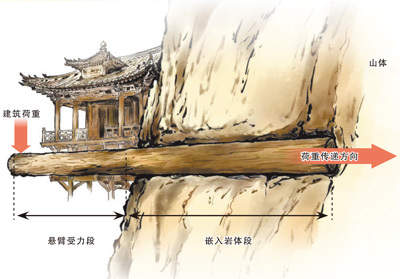 悬空寺悬臂梁结构剖面图。马睿姗绘
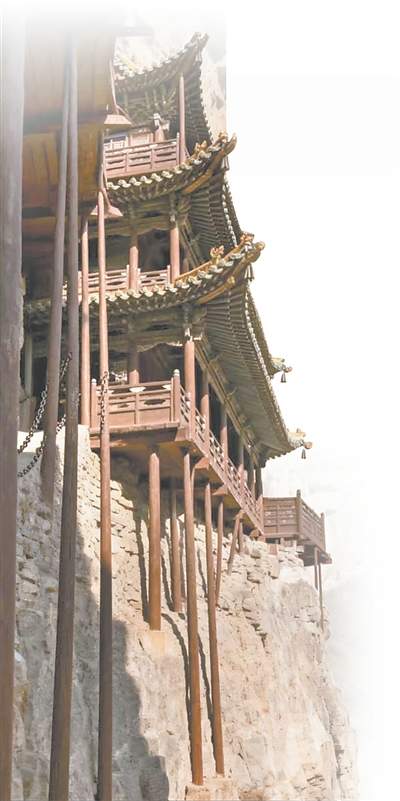 悬空寺近景。

B | 资料图片 山西大同浑源县东南,北岳恒山金龙峡翠屏峰绝壁之间,悬空寺凌空嵌于半山崖龛,红墙飞檐层叠错落,远观如悬于半空的楼阁画卷,气势恢宏,被古人誉为“天下巨观”。

C | 悬空寺,始建于北魏时期,是国内难得一见的佛、道、儒三教合一的寺庙。

D | 自建成之后,经过历代重修,迄今已有1500余年历史,1982年入选全国重点文物保护单位。 一木一石,顺势造就。整座寺院依托天然凹崖铺展,大小殿阁、栈道回廊依山排布,兼具险峻气势与中式建筑美学,生动诠释中式古建“天人合一”的营造理念。 凌空而嵌的“天下巨观” 站在地面上远望,楼阁如悬丝戏台;登临后近观,栈道仅容一人侧身而过,栏杆外便是万丈山崖。风声轻拂,仿佛还能听见千余年前北魏匠人的锤凿之声。 临近傍晚,游客散去,恒山风景名胜区管理中心悬空寺管理所所长岳利芳正在景区内进行日常巡查。自1993年到恒山景区工作以来,悬空寺她看了30多年。“仿佛一座琼楼玉宇从天而降,怎么也看不够。

E | ”岳利芳边走边说。 “悬空寺的‘悬’,是选址巧思、力学原理与选材智慧的体现。

F | ”岳利芳讲道,寺宇背倚危崖、下临深谷,采用“一院二楼”布局,飞楼间仅靠悬空栈道相连。 悬空寺营造技艺的重点是“半插飞梁为基,巧借岩石暗托”。 工匠先在坚硬的石灰岩上凿出深石窝,选取耐腐防虫的铁杉木,以桐油浸泡防腐,再将27根锥形铁杉木作为横梁,2/3部分嵌入岩体,木梁后端加木楔撑开,形成自锁固定结构;外露梁头立柱分散侧向应力,所有梁柱、楼板、栏杆以榫头榫槽紧密扣合。

G | 而看似撑起整座楼阁的细长立柱,实则悬而不承,并非主要承重构件。全寺不施一钉一铆,完全依靠榫卯咬合串联梁柱,形成稳定结构,再加上天然山体庇护,让这座古寺在历经风霜、多次地震后仍稳固矗立。 “悬空寺是借助山的力量挺立。很多游客看到了都感慨,‘不愧是我们可爱又迷人的老祖宗啊!’”岳利芳笑着说。 为什么要悬空而建? 恒山风景名胜区管理中心文化研究学者李向奎认为,悬空修建是受了军事防御、地理空间、宗教、防灾等多重因素影响。 北魏时期,战乱频发,平地建筑极易遭战火、盗匪损毁。

H | 悬于悬崖半空,能一定程度躲避兵祸侵扰,保全寺院。 其次,从地理空间看,翠屏峰山脚河谷地带狭小,常年受山洪冲刷,不适合大规模营建;山体崖壁平整坚硬,利用垂直崖面既能拓展建筑空间,还能避开河道水患。 “古人认为,上有天、下有地,居崖壁之间通天地灵气,悬崖半空介于天地之间,是修仙、礼佛的绝佳之地。”李向奎说。 悬空而建,还具备天然防灾优势。顶部山体天然形成巨大石檐,雨水无法直接冲刷木构殿宇,能大幅减少雨水侵蚀;崖壁可以遮挡狂风、烈日,减缓木材损害,延长古建筑寿命。

I | 专家研究认为,这座始建于北魏的附崖建筑,将木飞梁插入崖壁、依靠悬挑受力,是北方崖壁悬空建筑的典型代表。它“借架空以适配山地环境”的营造理念,和西南干栏吊脚楼遥相呼应,二者因地制宜,各有巧思,有异曲同工之妙,共同构成我国古代山地木构建筑两条并行的技术脉络。 浑源县文物保护研究中心主任杨毅认为,“只需要几根悬臂梁承载住建筑重量,就能历经上千年却不腐不朽,它是建筑史上的一个奇迹。” 给悬空寺装上“听诊器” 历经千年风雨洗礼的悬空寺,如今正面临着诸多考验。 旅游旺季的人流激增,周边施工时的环境振动,山体风化、雨水冲刷等自然因素,以及大同盆地存在的地震风险等,均为古建保护带来挑战。 “科学摸排健康状况、排查潜在风险,是文物抗震保护的关键。我们需要根据它们‘身体’的实际情况制定个性化保护方案。

J | ”恒山风景名胜区管理中心悬空寺管理所副所长高枭介绍。 2026年4月,山西悬空寺建成分布式光纤振动风险感知系统。工作人员在悬空寺的栈道和南、北楼的关键梁、柱等核心部位,布设了光纤传感网络。

K | 高枭表示:“这套系统仿佛给古建植入‘传感神经’、装上‘听诊器’,能在不破坏结构的前提下,实时监测地震、工业振动及人流走动带来的微小荷载,为结构健康风险预警和游客调控提供科学依据。” 除此之外,悬空寺内部还安装了古建筑专用多功能红外长短波复合探测器,具备高清可见光图像人工智能识别火灾功能,能实时监测温度场动态分布,及早发现早期阴燃火灾隐患。 沉浸式感受古建奥秘 晚上,当暮色笼罩恒山,上千名游客在步道静待大型实景光影演出《何以悬空寺》启幕。超3.7万平方米的整片翠屏峰绝壁化作巨型裸眼3D荧幕,山水、古建、光影融为一体。 行至悬空寺正对的主观景台,演出进入高潮篇章《绝壁生佛·营造》,千米崖壁还原北魏工匠开山造寺全过程:崖壁之上,光影勾勒榫卯搭建、楼阁逐层悬挑、匠人腰系绳索悬空凿岩、一根根铁杉木梁横向嵌入岩体,动态再现建筑营造巧思。游客全程凝神仰望,惊叹声随光影变幻此起彼伏,在深度体验中,逐渐读懂千年古建背后的工匠智慧。 “《何以悬空寺》深度融合恒山文化、悬空寺历史等本土特色元素,在严守文物保护底线的前提下,让静态文物在夜色中‘活’起来,既激活了浑源县的夜间经济,也为古建活化利用、文旅深度融合探索新路径。”恒山风景名胜区管理中心市场营销部部长朱少龙介绍。 每年旅游旺季,单日客流平均达3万人次,由于每日登临名额有限,超过90%的游客无法登临悬空寺。在悬空寺景区一隅,MR(混合现实)项目“灵境悬空”弥补了无法登临游览的遗憾。游客只需头戴MR眼镜,虽然身在平地,却获得飞跃至寺庙上空的游览体验,沉浸式游览悬空寺各个主殿,近距离观赏寺内现存唐代造像、明代泥塑、历代碑刻等文物,配合同步讲解,更能直观感受悬空寺的力学结构、依山选址的地理奥秘。 “之前看纪录片就觉得震撼,来到现场发现真是巧夺天工,就像挂在崖壁上的工艺品一样精致!”河北游客刘女士感慨。

L | 曲终灯灭,悬空寺重归静谧。

M | 历经千年沧桑,悬空寺这座彰显了中华民族包容和合的文化精神的古建筑,在传统与现代的交融中,将东方智慧继续传扬。

N |
Current article:http://bg3.yizhougengcuohei.cyou/list_yf7hxm/zwtdq3.html
Published on:13:59:52

国内/08-23

国内/08-24

国内/08-24

国内/08-26

国内/08-20

国内/08-24

国内/08-23

国内/08-26

国内/08-24